On 9 July 2027 something changes at the roadside check. From that day every authority in the EU must accept freight information electronically. If the company provides it that way. That is Article 5 of the eFTI regulation (EU) 2020/1056. Four legal acts belong to it. The latest so far came on 6 November 2025. Most texts about it call it "the digital consignment note". That is the smallest layer of it.
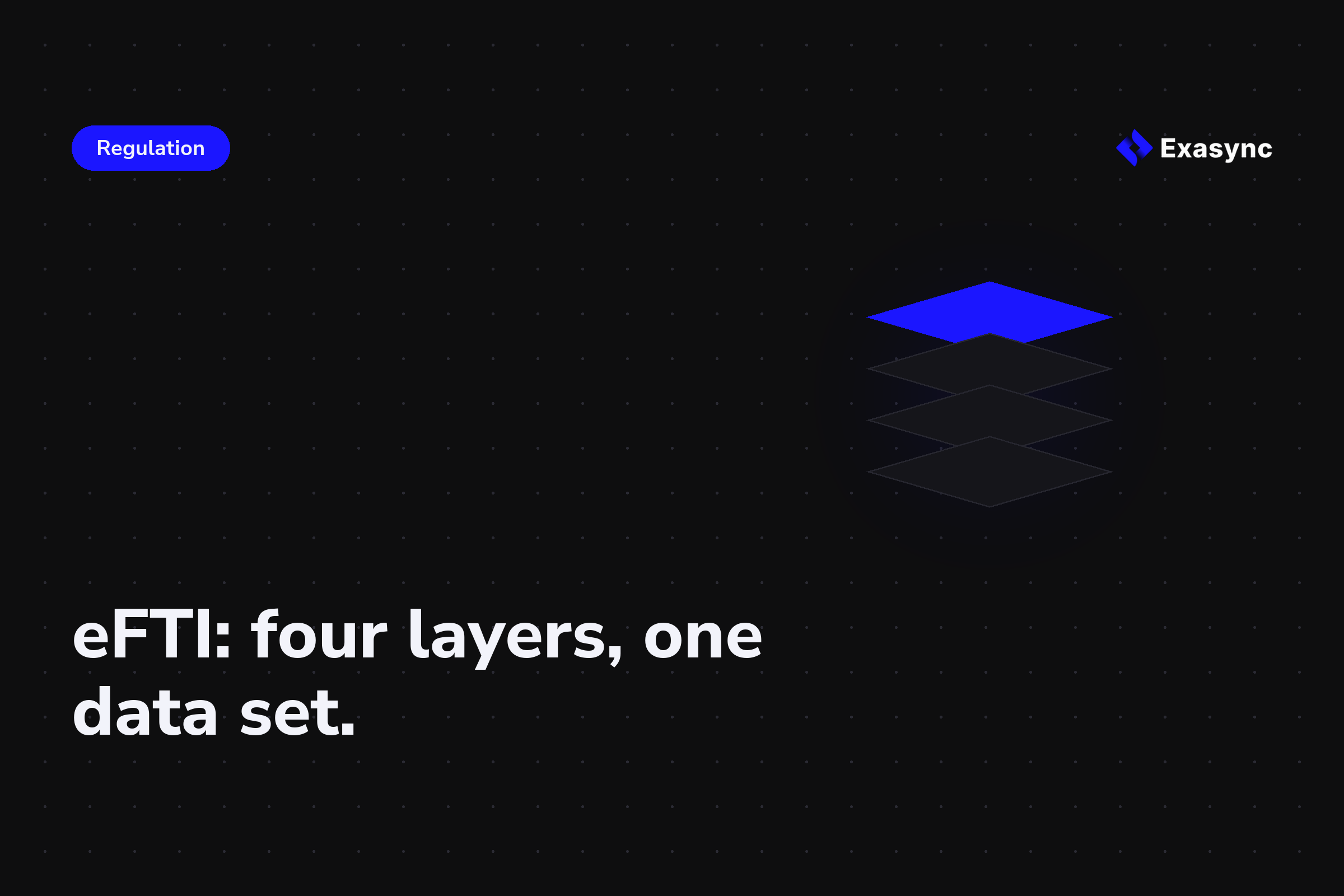
The eFTI regulation is a data system. Four layers, built on top of each other. A data set. A certified platform. An access path for authorities. And the operation in your own house. Whoever knows the layers knows where to start. (Spoiler: not with the platform.)
The regulation does not cover everything in the cab. Article 2 lists them. The transport document under the old Regulation No 11. The evidence for combined transport. The proof for cabotage operations. The papers for waste shipments. The transport document for dangerous goods under ADR. Air cargo security from Annex I comes on top. Five document types on the road, all with an authority behind them. The CMR consignment note itself is not on the list. It is a contract document, not an authority document. (That is why the eCMR runs under its own law. I wrote about that last week.)
Each document type has its own data subset. They are laid down in Delegated Regulation 2024/2024. Every data element there has an identifier, a format and a length. Weight: a number with three decimals. Unit: a code from a list, KGM or TNE. I counted the annex: about 530 identifiers. Not all of them apply to every trip. But three document types share many of them. Sender, consignee, goods, quantity, vehicle.
That is the actual message of this layer. The fields are fixed. If your TMS names them differently, you translate. If your TMS does not have them, you capture them.
Article 4 says how data is provided. If you provide it electronically, you use a certified eFTI platform. Machine-readable. On request also readable for humans. On site, on the screen of your own device. No printout needed.
What a platform must be able to do is in Article 9. Eleven points. The ones that matter to a carrier: access only after authentication. A processing log per data element, with the person and the sequence. If a value changes, the old one is kept. A unique reference per consignment. The details sit in Implementing Regulation 2025/2243 of 6 November 2025.
A conformity assessment body certifies the platform. It is accredited in one Member State. The certificate is valid in all of them. Every country keeps a list of certified platforms. The Commission writes that platforms have been able to prepare since January 2026. It plans to adopt the remaining specifications by December 2026.
A carrier does not build this platform. He picks one. The connection is then an API to a third-party system. Like the TMS, like telematics. That is our daily work. It is the part that worries me least.
This is where it gets technical, and where it gets interesting. The authority does not log in to the platform. It receives a link. Implementing Regulation 2024/1942 calls it the UIL. A unique identifying link per consignment. The driver shows it as a QR code. On a phone, a tablet or printed on paper. For checks at the company's premises, the authority can also receive the link by mail.
Behind it runs a network. Every Member State operates an eFTI gate. The inspector uses an access point of his authority. The request goes to the gate of his country. From there to the gate of the country that certified the platform. Then to the platform. The answer takes the same way back. Format: XML. Transport: eDelivery, the EU standard for secure messaging.
For the dispatcher this means: the UIL is a new mandatory field on the order. It is created when the record sits on the platform. It has to be with the driver before the trip starts. And it has to belong to the right consignment. A mixed-up link in 2027 is what a forgotten folder is today.
The three layers above are law and technology. The fourth is organisation. It is the one where projects get stuck.
For dangerous goods the consignor supplies the transport document. The carrier receives it. If it is to arrive electronically, the consignor has to write into the platform. Or the carrier captures it from the PDF. For cabotage it is the other way round. The evidence comes from the carrier itself. With a subcontractor, it sits with the subcontractor. Peter Kretz of msg named subcontractors as the hurdle in March 2026. I see it the same way.
This is the build order, thought from the back. First, count the trips that fall under one of the five document types. Second, map the fields of each document type against its data subset. What sits in the TMS, what in the dispatch plan, what only in the consignor's PDF? Third, close the gaps. That is order capture from mail and PDF, dispatch plan import, telematics. All building blocks from logistics operations that already exist. Fourth, and only then, pick and connect the platform. Fifth, the UIL back into the TMS, onto the order, onto the driver's device.
An honest caveat. We have not connected an eFTI platform yet. I have not found a list of certified platforms in any country. Whether the gates are running, I do not know. Steps one to three we have built at customers, for other purposes. Steps four and five are a concept. If you have a platform in pilot: that is the part of the picture I am missing.
Three places where I expect trouble in 2027. All three sit in operations, not in the law.
First, the printout as fallback. Paper stays allowed. The German transport ministry says so in one sentence. So some companies will run two tracks. Record on the platform, sheet in the cab. Two truths that can drift apart.
Second, master data. A consignee with three spellings in the TMS becomes three consignees in the record. The platform checks format and length. It does not check whether the name is right.
Third, timing. The UIL has to exist before the trip. Whoever dispatches at 5 a.m. and completes the data at 9 a.m. has no link at the 7 a.m. check.
The Commission estimates the sector's saving at one billion euros a year. I do not believe that number, and I do not believe its opposite. The eFTI field list is what I trust. It is real, it is public, and it fits in a spreadsheet.
Which of the five document types rides along most often in your fleet? Name that one, and I map its fields against your order. One hour of work. After that you know which layer is missing at your company.